



 Artificial Intelligence
 Augmented & Virtual Reality
 Internet of Things
 Custom Software Development
 ERP Development
 Mobile Application Development
 Web Application Development
 Web Designing
 E-Commerce

AR/VR Development Company in Dubai, UAE – Building Immersive Digital Experiences
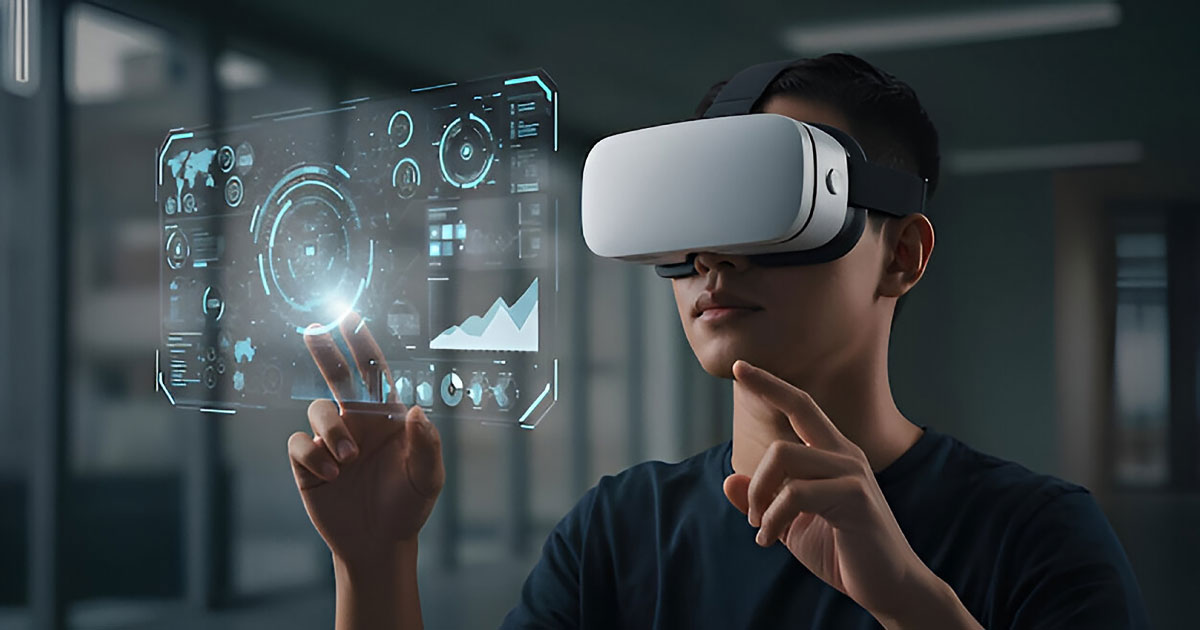
Dubai is rapidly emerging as a global hub for emerging technologies, with businesses across industries adopting immersive technologies to create more engaging digital experiences. Augmented Reality (AR) and Virtual Reality (VR) are changing how organizations present products, train employees, interact with customers, visualize spaces, and deliver digital experiences.
```As a leading AR/VR development company in Dubai, UAE, we build immersive digital solutions that combine interactive experiences, 3D visualization, real-time interaction, and modern application technologies. Our solutions are designed to help businesses use AR and VR to solve practical challenges while creating memorable experiences for their customers and teams.
From augmented reality applications and virtual showrooms to immersive training environments, 3D property walkthroughs, product visualization, and interactive simulations, AR and VR technologies are opening new opportunities for digital transformation across Dubai and the UAE.
What Are AR and VR Technologies?
Augmented Reality and Virtual Reality are immersive technologies that change how users interact with digital information and physical environments.
Augmented Reality (AR) overlays digital content such as 3D models, animations, information, or interactive elements onto the user's real-world environment. AR can be accessed through smartphones, tablets, smart glasses, and other supported devices.
Virtual Reality (VR) creates a computer-generated environment that users can explore and interact with using VR headsets and controllers. VR is particularly useful for simulations, training, virtual tours, entertainment, and experiences where complete environmental immersion is required.
Businesses can use either technology independently or combine AR, VR, 3D, AI, IoT, and other technologies to create more advanced immersive solutions.
Why AR & Virtual Reality Matter for Businesses in Dubai
Customer expectations are changing rapidly. Traditional websites, images, and videos may not always provide enough information for customers to understand complex products, properties, environments, or services.
AR and VR allow businesses to create interactive experiences where customers can explore, visualize, and understand products or environments before making decisions. This can be particularly valuable for industries such as real estate, retail, education, healthcare, tourism, manufacturing, and marketing.
With smart city initiatives and digital-first strategies, virtual reality in Dubai is becoming an increasingly relevant technology for businesses seeking new ways to engage users and differentiate their digital experiences.
- Immersive customer and brand experiences
- Enhanced product visualization and demonstrations
- Interactive property and architectural visualization
- Improved employee training and simulation
- More engaging marketing campaigns
- Reduced physical prototyping requirements
- Better visualization of complex concepts
- Higher user engagement and interaction
Custom AR/VR App Development Services
Every business has different requirements, which is why custom development is important for organizations planning to adopt immersive technologies. We deliver end-to-end custom AR/VR app development services tailored to specific business objectives, target audiences, and industry requirements.
Our development approach combines immersive design, 3D technology, application development, backend integration, and performance optimization to create solutions that are practical as well as visually engaging.
- Augmented Reality mobile applications
- Web-based AR experiences
- Virtual Reality applications
- VR training and simulation platforms
- 3D visualization and immersive walkthroughs
- Virtual showrooms and product demonstrations
- Interactive product configurators
- AR-powered marketing experiences
- Virtual events and digital experiences
- AR/VR integration with enterprise systems
AR/VR for Real Estate and Property Development
Real estate is one of the industries where immersive technology can provide significant value. Property buyers often need to understand spaces, layouts, finishes, and surroundings before a project is completed.
AR and VR can allow potential buyers to explore properties through immersive walkthroughs and interactive 3D environments. Developers can showcase apartments, villas, commercial spaces, and upcoming projects without requiring customers to physically visit every location.
- Virtual property tours
- 3D architectural visualization
- Interactive floor plans
- Virtual showrooms
- Interior visualization
- Off-plan property experiences
These experiences can help real estate businesses communicate design concepts more effectively and provide potential buyers with a clearer understanding of properties.
AR/VR in Retail and E-commerce
AR is also changing the online shopping experience by helping customers visualize products before purchasing. Instead of relying only on static product images, businesses can allow users to interact with three-dimensional product models.
For example, customers may be able to visualize furniture inside their homes, explore product details, preview accessories, or interact with a 3D model before completing a purchase.
Retailers and e-commerce businesses can use AR to create interactive product experiences that bridge the gap between physical and digital shopping.
AR/VR for Training and Education
Traditional training methods are not always effective for complex or practical subjects. VR can create controlled simulation environments where learners can practice procedures and scenarios without the risks or costs associated with real-world training.
Educational institutions and organizations can use immersive technologies to create interactive learning environments, practical simulations, virtual laboratories, technical training, and employee onboarding experiences.
- Employee training simulations
- Technical skill training
- Virtual classrooms
- Safety training
- Virtual laboratories
- Interactive educational experiences
AR/VR in Healthcare
Healthcare organizations can use immersive technologies for education, visualization, training, and simulation. VR can create controlled environments for medical training, while AR can provide interactive visual information in appropriate healthcare applications.
AR and VR solutions can support medical education, anatomy visualization, surgical simulation, rehabilitation experiences, and healthcare training. Applications involving clinical decisions or patient care require appropriate professional validation, security, and regulatory considerations.
AR/VR for Tourism and Hospitality
Dubai's tourism and hospitality sector provides another strong opportunity for immersive technology. Hotels, attractions, travel companies, and tourism organizations can use AR and VR to provide virtual previews of destinations, rooms, attractions, and experiences.
Virtual tours can help potential visitors explore locations before traveling, while AR experiences can provide interactive information and digital content during physical visits.
- Virtual hotel tours
- Destination previews
- Virtual attractions
- Interactive travel experiences
- AR city guides
- Immersive marketing campaigns
AR/VR in Manufacturing and Industrial Applications
Manufacturing and industrial organizations can use immersive technologies to visualize machinery, train employees, support maintenance, and improve product development processes.
AR can provide technicians with contextual digital information while working with equipment, while VR can be used for training and simulated industrial environments.
Immersive technologies can also reduce the need for physical prototypes in certain design and visualization workflows, allowing teams to evaluate concepts digitally before moving into physical production.
3D Visualization and Virtual Experiences
Three-dimensional visualization is a major component of many AR and VR applications. High-quality 3D models can transform complex products, buildings, machines, and environments into interactive digital experiences.
Businesses can use 3D visualization for product demonstrations, architectural presentations, virtual showrooms, training environments, digital twins, and interactive marketing.
Combining 3D content with AR or VR allows users to explore digital objects from different perspectives and interact with information in a more intuitive way.
AR/VR Combined With AI
The integration of Artificial Intelligence with AR and VR is creating new possibilities for intelligent immersive experiences. AI can help applications understand user interactions, personalize content, analyze behavior, and generate or manage digital information.
For example, AI-powered virtual assistants can be integrated into immersive environments to guide users through training or product experiences. AI can also support object recognition, speech interaction, personalization, and intelligent content recommendations.
The combination of AI, AR, and VR can help businesses create immersive experiences that are not only visually engaging but also responsive and intelligent.
AR/VR and IoT Integration
IoT provides real-time information from connected devices, while AR and VR provide visual interfaces for interacting with that information. Combining these technologies can create powerful applications for industrial, real estate, logistics, smart building, and infrastructure use cases.
For example, an AR application could display real-time information about connected equipment, while a VR environment could simulate the operation of an industrial facility using data from IoT systems.
This convergence of technologies can create more connected and interactive digital ecosystems.
Benefits of Custom AR/VR Development
Custom AR/VR development allows organizations to build immersive experiences around their specific business objectives instead of depending entirely on generic applications.
- Better customer engagement: Create interactive experiences that encourage users to explore and interact.
- Improved visualization: Present products, properties, and concepts in three dimensions.
- Enhanced training: Provide realistic simulation-based learning environments.
- Faster product demonstrations: Showcase products without always requiring physical samples.
- Reduced prototyping costs: Visualize concepts digitally before physical development.
- Brand differentiation: Deliver memorable experiences that help businesses stand out.
- Scalable experiences: Extend immersive applications across multiple locations and user groups.
AR/VR Development Technologies
Developing a high-quality immersive application requires the right combination of hardware, software, 3D assets, application frameworks, and backend technologies.
Depending on the project requirements, AR/VR solutions can involve:
- AR-enabled smartphones and tablets
- Virtual Reality headsets
- 3D modeling and rendering technologies
- Computer vision and spatial tracking
- Real-time 3D engines
- Cloud and backend infrastructure
- APIs and enterprise integrations
- AI and machine learning
- IoT connectivity
- Web and mobile applications
Performance and User Experience in AR/VR
Immersive applications require careful attention to performance and usability. High-quality graphics alone are not enough to create a successful AR or VR experience.
Applications need optimized 3D assets, efficient rendering, responsive interactions, intuitive navigation, appropriate device compatibility, and stable performance.
User experience is especially important in VR because poor performance or badly designed interactions can negatively affect the experience. Professional development should therefore include device testing, performance optimization, interaction design, and usability testing.
How to Choose an AR/VR Development Company in Dubai
Choosing the right technology partner is an important step for businesses planning an immersive technology project. AR/VR development involves multiple disciplines, including application development, 3D design, user experience, hardware compatibility, backend integration, and performance optimization.
When evaluating an AR/VR development company in Dubai, UAE, businesses should consider:
- Experience in AR and VR application development
- 3D modeling and visualization capabilities
- Mobile, web, and enterprise application expertise
- Experience with immersive hardware
- AI and IoT integration capabilities
- Backend and API development expertise
- Performance optimization and testing
- Scalable architecture and ongoing support
Why Choose Wahmi Technologies for AR/VR Development?
At Wahmi Technologies LLC, we combine technology expertise, creative thinking, and industry knowledge to develop immersive digital solutions for businesses in Dubai and the UAE.
As an experienced AR/VR development company in Dubai, UAE, we focus on creating practical solutions that balance immersive design, performance, usability, scalability, and business objectives.
- Experienced AR/VR developers and 3D specialists
- Custom solutions aligned with specific business goals
- Interactive and high-performance immersive applications
- Web, mobile, and enterprise integration capabilities
- AI, IoT, and emerging technology integration
- End-to-end development and ongoing technical support
The Future of AR and VR in Dubai
The future of immersive technology in Dubai is expected to become increasingly connected with artificial intelligence, spatial computing, IoT, 3D technologies, and digital twins.
Businesses will increasingly move beyond simple virtual tours and demonstrations toward interactive digital environments that allow users to communicate, learn, purchase, collaborate, and make decisions within immersive experiences.
Real estate companies can create interactive digital properties, manufacturers can build virtual training environments, retailers can offer immersive shopping experiences, and educational organizations can develop more engaging learning environments.
As immersive technologies become more accessible across devices, AR and VR will continue to evolve from specialized applications into valuable components of broader digital transformation strategies.
Conclusion
AR and VR technologies are redefining how businesses communicate, train, sell, visualize, and interact with their customers and employees. In Dubai and across the UAE, immersive technology is creating opportunities across real estate, retail, education, healthcare, manufacturing, tourism, marketing, and other industries.
Investing in custom AR/VR app development services can help businesses create engaging experiences while improving visualization, training, customer interaction, and operational processes.
As AR and VR continue to converge with AI, IoT, 3D visualization, and spatial computing, businesses have the opportunity to build more intelligent, interactive, and future-ready digital experiences.
If you're looking for a reliable AR/VR development company in Dubai, UAE, Wahmi Technologies LLC can help transform your idea into a scalable immersive solution designed around your business objectives.